How to build a
night routine that
actually sticks
Forget the two-hour wind-down with candles and a ten-step skincare ritual. A routine that lasts is short, a little forgiving, and built around the evening you actually have.

In this article13 sections · 10 min
Search online for a night routine and you'll find evenings that look wonderful and take most of the night to complete: a long bath, a skincare sequence, journaling, stretching, herbal tea, twenty pages of a novel, lights out at a suspiciously early hour. They're lovely to look at. They're also built for someone with an empty evening and nobody asking where their shoes are.
Most of us have something messier. Homework that ran late. A child who needs one more glass of water. A shift that ends at a different time every week. Work that follows us home in our pockets. An evening routine that only works on calm nights doesn't help much, because calm nights are rarely the ones that need it.
The good news is that a bedtime routine for adults doesn't have to be impressive to be useful. A good one is simply a few calm steps you repeat in roughly the same order each night: put the phone away, bring the lights down, get ready for bed, and do one slow thing you enjoy. Twenty-five minutes is plenty, and it only has to happen on most nights. Here's how to build one that can.
Why elaborate routines fall apart
Ambitious routines tend to fail in the same few ways, and hardly any of them have to do with motivation.
- Too many steps. Every extra step is another place where the chain can break. Miss one, and it's easy to feel the whole thing is ruined.
- Too many conditions. If your routine needs a quiet house, a free bathroom and forty spare minutes, it vanishes the moment one of those is missing.
- All or nothing. When the routine is either done perfectly or not at all, the not-at-all nights start to win.
- Designed for your best evening. We plan for the version of ourselves who gets home on time with energy to spare. A better test is whether it would survive an ordinary Tuesday.
None of this means aiming low. It means making the routine small enough that you can still do it when the day hasn't gone to plan, which is often.
Start from the evening you actually have
Before designing anything, spend a few nights noticing what already happens. What time do you usually get into bed, as opposed to the time you think you should? What fills the last hour? What tends to push bedtime later: chores, messages, a show, the feeling that you haven't had any time to yourself yet? That last one is common enough to have a name: revenge bedtime procrastination.
You'll probably find you already have a routine of sorts. You brush your teeth, lock the door, plug in a phone, switch off a light. Those existing steps are useful, because they're anchors. New habits attach far more easily to something you already do than to a time on the clock. "After I brush my teeth, I put my phone on the charger" is easier to keep than "at 10:30 I stop using my phone."
A realistic 25-minute bedtime routine
Here's what a simple, achievable routine might look like for someone hoping to be asleep around 11. It's an example, not a prescription. Shift the times, swap the steps, and keep the shape if it helps.
- Close the day 5 min
Glance at tomorrow, lay out what you'll need first thing, and write down anything you're worried you'll forget.
- Park the phone 2 min
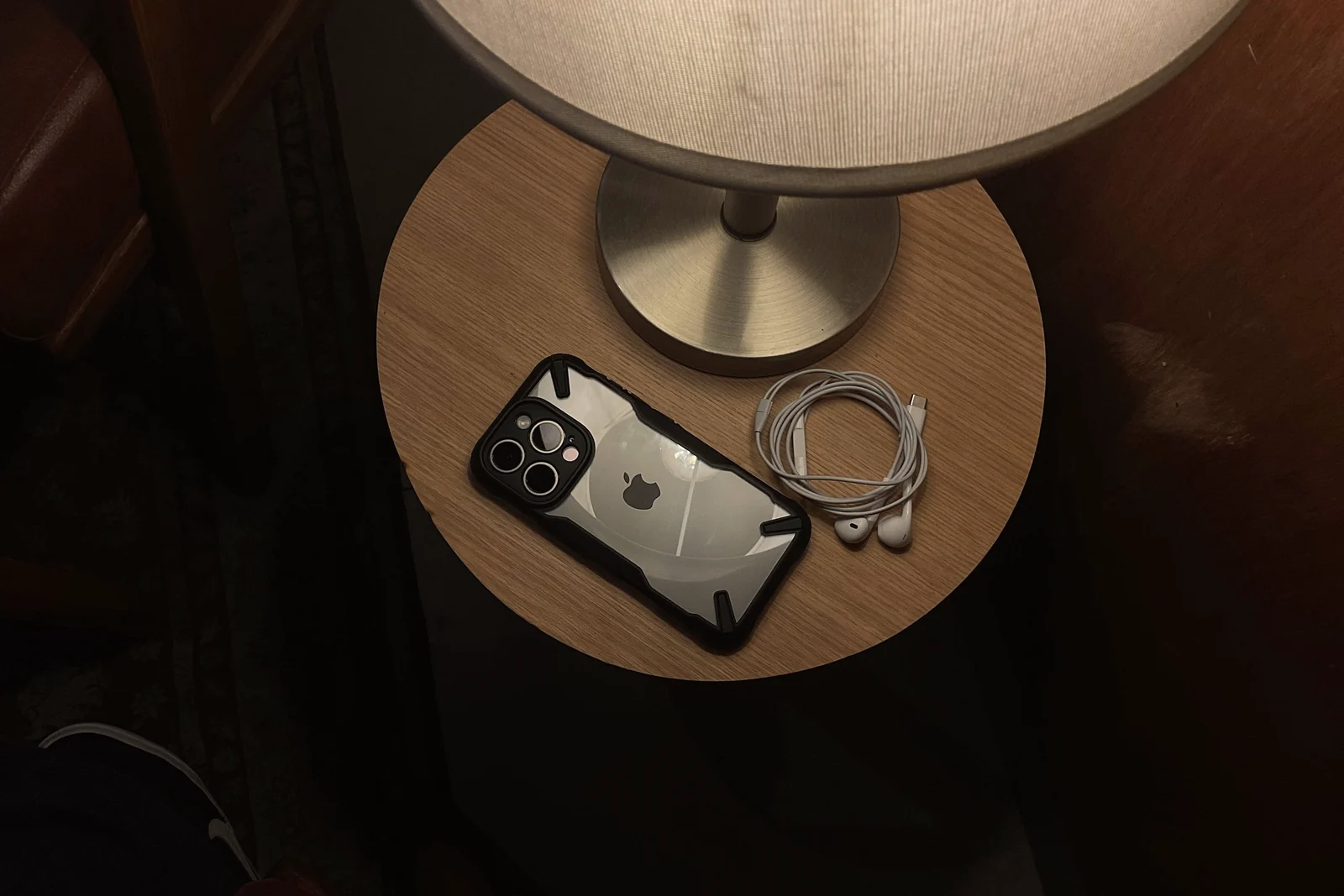
Put it on charge somewhere you can't reach from bed. Switch off the big light and turn on a lamp.
- Get ready for bed 8 min
Teeth, face, something comfortable to sleep in. Whatever your version is, keep it roughly the same each night.
- One slow thing 10 min
Read, stretch or talk. Something calm that has a natural ending.
- Lights out
No goal beyond resting. Sleep usually comes more easily when you aren't chasing it.
Notice what's missing. There's no page count, no meditation you have to finish, no rule about what to drink. Every step is easy to do badly and still count.
How long should a bedtime routine be?
Long enough to mark the end of the day, short enough to survive a busy one. The Sleep Foundation describes a bedtime routine as a set of activities done in the same order in the 30 to 60 minutes before bed, and suggests starting with one or two changes at a time. The 25-minute example above sits just under that range on purpose: a routine short enough to start tonight is one you're more likely to keep, and on hard nights even a two-minute version counts.
Prepare for tomorrow so tonight can end
A lot of late-night restlessness isn't really about tonight. It's about tomorrow: the meeting, the deadline, the form you still haven't signed. Unfinished tasks have a habit of resurfacing exactly when the room goes quiet.
A few minutes of preparation can close some of those loops. Put your keys and bag by the door. Check the first thing in tomorrow's calendar. Lay out clothes if your mornings are rushed. Most usefully, write down whatever is on your mind. In one small sleep-lab study, people who spent five minutes writing a specific to-do list before bed fell asleep faster than people who wrote about tasks they'd already finished. A single study proves very little on its own, but the habit is cheap and easy to test for yourself.
Paper works better than your phone for this. Opening a notes app is a very short walk from opening everything else.
Your wind-down routine: turn the volume down
Winding down has less to do with adding calming activities than with removing stimulating ones. In the last half hour or so, try steering away from the things that wake your mind up:
- Bright overhead lights. Switching to a lamp or two is a simple signal that the day is ending.
- Work email and messages that need a reply. They'll still be there in the morning.
- News, arguments, and anything you know tends to wind you up.
- Hard exercise right before bed, if you notice it leaves you wired.
- Feeds and autoplay, which are designed to have no natural stopping point.
A few things work on a longer fuse, so handle them earlier in the day. The CDC's healthy sleep habits include avoiding caffeine in the afternoon or evening, skipping large meals and alcohol before bedtime, and keeping the bedroom quiet, relaxing and cool.
You don't have to cut everything. The idea is to let the hour before bed get gradually quieter than the hours before it. If the phone is the hardest part, our guide on how to stop using your phone before bed goes into the why and the how in more detail.
Choose one calm thing you enjoy
The heart of a routine is the part that feels good. If every step feels like a chore, the routine won't last. Choose one calming activity you actually look forward to, and let it be the reward for putting the day away.
Reading is a classic for good reason: it's absorbing, it ends when you decide, and paper doesn't send notifications. Gentle stretching works well if you've been sitting all day, as long as it stays slow; this isn't the moment for a workout. A few lines in a notebook help if your mind tends to race. Others prefer music, a quiet conversation or a warm shower. There's no right choice, only the one you'll keep doing.
Late nights, early starts, and nights that go sideways
Some evenings simply won't cooperate. You'll be out late, a child will be ill, a shift will overrun, or you'll be sleeping somewhere unfamiliar. Rather than abandoning the routine on those nights, it helps to have a shorter version ready.
Think of it as the two-minute routine: phone to its charging spot, lights down, and one small thing that marks the end of the day, like a page of a book or a glass of water by the bed. It won't feel like much, but it keeps the habit alive. On a normal night you do the full version; on a hard night, the short one. Either counts.
If your schedule changes from week to week, anchor the routine to your bedtime rather than a clock time. Whenever bed happens to be, the routine starts about half an hour before it.
Consistency without perfectionism
It helps to judge consistency across a week rather than night by night. Doing your routine five nights out of seven is a real routine. Missing one doesn't send you back to zero.
A routine isn't something you pass or fail each night. It's a path you can find again in the dark.
Sleep specialists also often point out that a regular wake-up time matters as much as a regular bedtime, because it gives your body clock a steady anchor. The NHLBI, part of the US National Institutes of Health, recommends going to sleep and waking up around the same time each day, weekends included. If your evenings are unpredictable, getting up at roughly the same time on most days can help bedtime settle into a pattern on its own.
Keep track loosely, if at all. A tick on a calendar can be motivating. A detailed spreadsheet usually isn't.
Make it yours
No routine suits everyone, and copying someone else's is rarely the best place to start. A few things worth thinking about:
- If you're a natural night owl, forcing an early bedtime may just mean lying awake. Work with a later schedule where your life allows it, and keep the routine itself consistent.
- If you're a parent, your routine may have to start after theirs ends, and it may be shorter. That's fine.
- If you're a student, late study sessions happen. Try to leave even ten minutes between closing the laptop and closing your eyes.
- If your mind races, move writing things down earlier in the evening, and choose a calm activity that gently holds your attention, like reading or an audiobook.
A routine can make evenings calmer and help you get to bed when you mean to. It isn't a treatment for sleep problems. If you regularly struggle to fall or stay asleep, or feel exhausted despite enough time in bed, it's worth talking to a doctor.
A starter bedtime routine to make your own
If you'd like somewhere to begin, try this for a week and adjust as you go:
- Set a wind-down reminder. Put an alarm on for thirty minutes before you want to be asleep, and give it a friendly name like "start the slow part."
- Put tomorrow on paper. Write down the first task for the morning and anything else that's on your mind.
- Park your phone. Put it on charge somewhere you can't reach from bed.
- Bring the lights down. Switch off the overhead light and use a lamp instead.
- Do one slow thing. Read, stretch or talk for about ten minutes, then turn out the light.
Change anything that doesn't fit. A routine you've adjusted to suit your life will outlast a perfect one borrowed from someone else. And if your phone keeps winning the last half hour, these practical ways to reduce screen time before bed can make it less tempting.
Common questions about bedtime routines
What's a good bedtime routine for adults with ADHD?
The same shape, with more help from outside. Many people with ADHD have a body clock that runs late, so choose a realistic bedtime rather than an aspirational one and keep your wake-up time steady. Let cues do the remembering: an alarm that starts the routine, the phone already parked out of reach, tomorrow's tasks on paper. If you take stimulant medication, ask your prescriber whether its timing could be affecting your sleep.
Can a bedtime routine help with insomnia?
A calm routine is a good foundation, but it isn't a treatment on its own. If you're lying awake and getting frustrated, get up and do something quiet in dim light until you feel sleepy, a technique sleep specialists call stimulus control. If poor sleep has gone on for weeks or keeps affecting your days, talk to a doctor. The usual first treatment for long-term insomnia is cognitive behavioral therapy for insomnia (CBT-I), a structured program that typically runs six to eight weeks.
One small step for tonight
Don't try to build the whole routine tonight. Just choose your anchor: the thing you already do every evening that will mark the start of winding down. Brushing your teeth works well. Tonight, right after you do it, put your phone on charge somewhere out of reach. For now, that's the routine. Everything else can be added later, one small piece at a time.